Technology
AI Search Visibility Audit Frequency: Tracking ChatGPT, Claude, and Gemini Results in 2026
Discover the optimal frequency for auditing your business presence in AI search models like ChatGPT and Gemini. Learn how to distinguish between temporary AI fluctuations and significant visibility trends in 2026.
By Frank Marino · · 5 min read
AI search visibility is the measurable presence of a brand within the responses generated by large language models like ChatGPT, Claude, and Gemini. It indicates whether an AI assistant recommends your business or mentions a competitor when a user asks for professional services or products.
Establishing a consistent audit routine for AI search visibility is essential for any business operating in 2026. Unlike traditional search engine optimization, which relies on relatively stable algorithms, generative AI results can shift based on model training cycles and real-time data integration. Understanding when and how to check your presence ensures you are making decisions based on reliable data rather than temporary variations. You can visit GEO Sentinel AI for a free audit to see how your business appears across these platforms.
Why does AI search visibility matter in 2026?
Consumers increasingly rely on AI assistants to filter information. When a user asks Perplexity for a recommendation, the AI synthesizes multiple sources into a single answer. If your business is not included in that synthesis, you are effectively invisible to that user. This form of discovery has replaced many traditional search queries. Being named by an AI model provides a level of perceived authority that a standard blue link does not. In 2026, brands must treat their visibility within these models as a primary performance indicator. Failure to monitor these results means allowing competitors to capture market share in the growing conversational search space.
How often should I check my business in AI models?
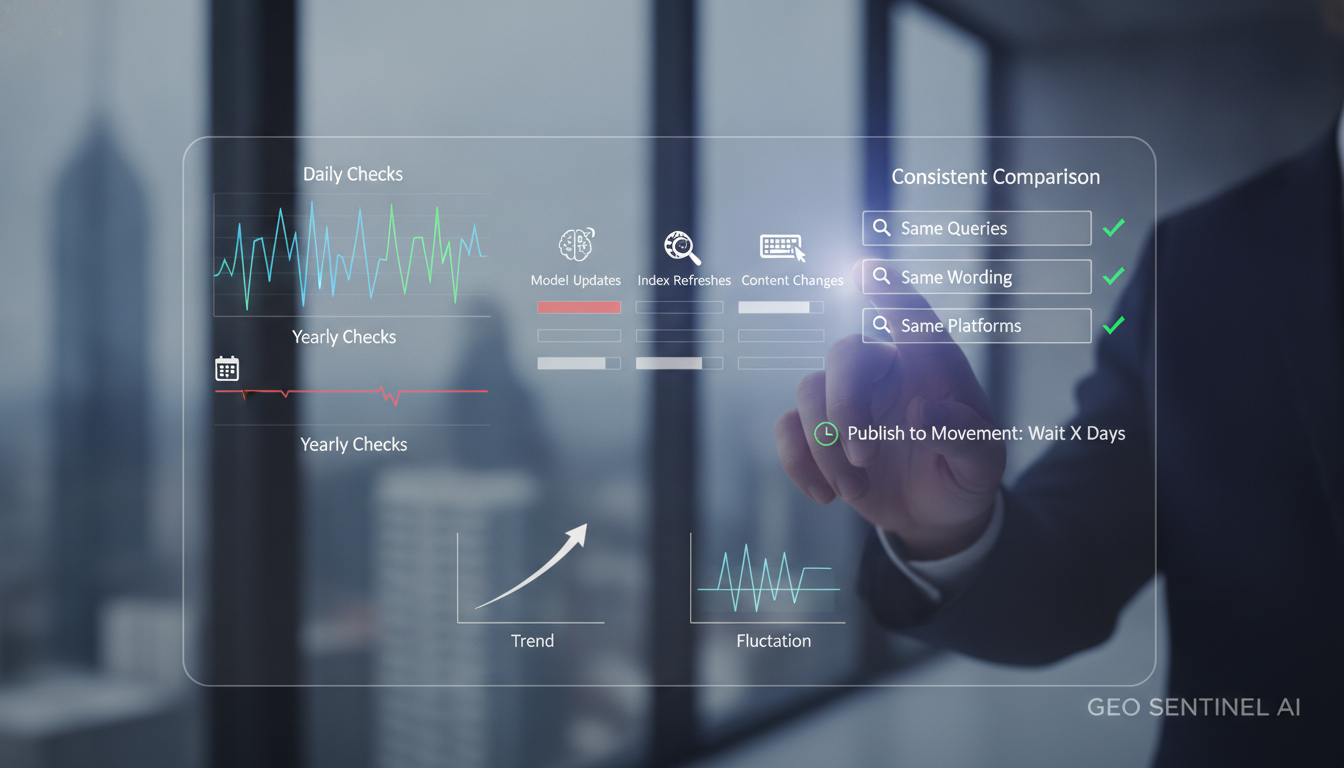
Checking your visibility every day often leads to unnecessary stress. AI models are known for stochastic behavior, which means they may produce slightly different outputs for the same prompt. These daily fluctuations are usually noise. If you react to every minor change, you might waste resources on problems that do not exist. Daily tracking is rarely productive for long-term strategy.
Conversely, checking your visibility once a year is insufficient. The AI landscape moves too quickly for annual reviews. Models like ChatGPT and Gemini undergo significant updates and fine-tuning several times throughout the year. If you only audit your presence annually, you will miss the impact of these updates. You may find that you have been missing from recommendations for months without knowing. A monthly or quarterly audit schedule is typically the best approach. This frequency allows you to identify genuine shifts in how models perceive your brand while ignoring the daily noise of generative responses.
What factors cause AI search results to change?
Several distinct factors influence how an AI model lists your business. The first factor is a model update. When companies like OpenAI or Anthropic release a new version of a model, the internal weights and rankings change. This can cause a business that was previously recommended to disappear or a new competitor to emerge.
The second factor is an index refresh. Tools like Perplexity and the search-enabled versions of Gemini browse the live web. When these models crawl new content, their answers change. Your own content updates or new mentions of your brand on third-party sites can trigger these refreshes. The third factor is the feedback loop from user interactions. While less transparent, how users engage with AI responses can slowly influence future outputs. These factors move on different timescales, which is why a consistent audit schedule is necessary.
How do I maintain consistency in my AI search audits?
To determine if your visibility has actually changed, you must hold your testing variables constant. You must use the exact same queries and wording for every audit. Even a minor change in punctuation or phrasing can lead an AI to a different conclusion. If you ask about your business in one way in January and a different way in February, the results are not comparable.
Platform consistency is also vital. You should test against the same versions of ChatGPT, Claude, and Gemini each time. Using a mobile app for one audit and a desktop browser for another can sometimes introduce variables in how the models process the request. By maintaining a strict protocol for your queries, you ensure that any change in the results reflects a change in the model or the data environment rather than a change in your testing method.
When will new content appear in AI search results?
If you publish a new article or update your service pages, do not expect to see an immediate change in AI search visibility. The time it takes for new information to reach an AI model varies. Some models use live search tools to find current information, while others rely on periodic training updates. Even for models with live search capabilities, it takes time for the system to trust and prioritize new data. Most businesses should wait several weeks before expecting to see the impact of new content in their AI audits. The exact timing depends on the specific plan and model architecture being used. Checking too soon after a content update will likely result in a false negative.
What is the difference between an AI trend and a fluctuation?
A fluctuation is a temporary change that does not persist across multiple queries or sessions. You might see a competitor listed instead of you in a single chat session. If you start a new session or check again the next day and your business returns, that was a fluctuation. These are common in generative AI and should not be a cause for alarm.
A trend is a consistent movement in the data over time. If your brand was mentioned in 80 percent of queries in June but drops to 20 percent in July and stays there through August, you are seeing a trend. Trends indicate a fundamental shift in how the AI model evaluates your relevance. Identifying these trends requires historical data from repeated audits. Only by looking at multiple data points can you distinguish between a random error and a strategic problem that needs to be addressed.
Frequently Asked Questions
How does AI search visibility differ from regular SEO?
AI search visibility measures mentions within conversational AI responses whereas traditional SEO focuses on website rankings in standard search engine results pages.
Which AI models are most important to track in 2026?
Businesses should focus on the most widely used platforms including ChatGPT, Claude, Gemini, and Perplexity for a comprehensive view of their visibility.
Can I pay to be recommended by an AI assistant?
Most AI models currently generate recommendations based on data and training rather than direct paid placements similar to traditional search ads.
Why does a competitor appear in AI results when I have better SEO?
AI models evaluate relevance and authority based on broad training data and conversational context which may differ from the metrics used by traditional search algorithms.
How many queries should I use for a standard audit?
An audit should include a variety of queries representing different ways a customer might search for your services to ensure a representative sample of results.
Is the free audit at GEO Sentinel AI a one-time service?
You can use the free audit to get a baseline understanding of your current visibility across major AI platforms.