Technology
Why Geospatial AI is the Only Adult in the Environmental Monitoring Room
Stop setting environmental goals and start building monitoring systems. Geospatial AI is the upgrade humanity needs to manage its energy and its planet by replacing human error with machine precision.
By Frank Marino · · 5 min read
I’ve spent a lot of time studying the various ways humans fail. As it turns out, we fail often, and usually with spectacular enthusiasm. We are essentially moist robots running on buggy software, trying to manage a complex planet with tools that are about as effective as a spoon in a gunfight.
When most people think about environmental monitoring, they picture a "passionate" scientist in a lab coat standing in a swamp, clutching a clipboard while getting eaten alive by mosquitoes. That is a goal-oriented approach. And as you might know, goals are for losers.
If your goal is to "save the environment," you’ve already lost. It’s too big, too vague, and your willpower will evaporate the moment you smell a cheeseburger. What you actually need is a system—specifically, a system that doesn’t rely on human passion, human error, or human-grade bug spray.
That’s where Geospatial AI enters the room.
The System vs. The Goal
In my book How to Fail at Almost Everything and Still Win Big, I argue that systems are superior to goals because systems are repeatable processes that increase your odds of success over time. Geospatial AI (GeoAI) is the ultimate environmental system.
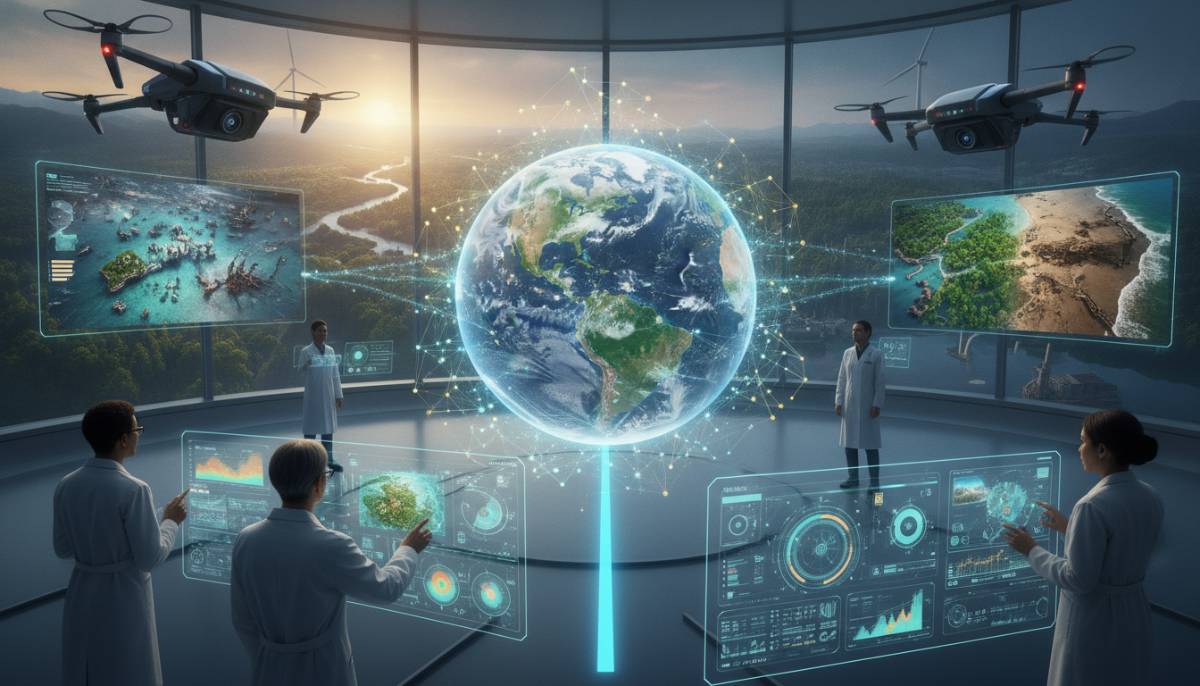
Traditional monitoring is a goal. You go out, you measure one tree, you write it down, and you feel a brief surge of moral superiority. GeoAI doesn’t care about your feelings. It uses a swarm of satellites, drones, and sensors to look at everything, everywhere, all at once. By combining geographic information systems (GIS) with artificial intelligence, it identifies patterns that a human brain is far too small—and far too distracted by TikTok—to ever notice.
It turns out that computers are incredibly good at being bored. They can stare at a million square miles of forest for twenty-four hours a day without needing a coffee break or wondering if their coworkers are whispering about them in the breakroom. This is the definition of a high-odds system.
The Reframe of the Century
Before we go any further, we need to fix how you look at this. Most people view environmental monitoring as a chore or a moral obligation. That’s low-energy thinking.
Usual Frame: Environmental monitoring is a noble, manual sacrifice performed by brave scientists in the mud.
Reframe: Environmental monitoring is a data-processing system that works best when humans stay out of the way.
Once you accept that humans are the bottleneck, the power of GeoAI becomes obvious. We are moving from "I hope we caught that oil spill" to "The system detected the leak before the oil even realized it was out of the pipe."
Satellites with Brains
Think of a satellite as a giant eyeball in space. A standard eyeball is useless without a brain to process the signal. In the old days, we had the eyeball (satellites), but the brain (humans) was too slow. we had to hire thousands of people to squint at photos and circle things that looked like illegal logging.
Humans are terrible at this. We get tired. We get hungry. We start seeing shapes in the clouds that look like Elvis or a favorable quarterly report.
GeoAI replaces the unreliable human brain with a machine-learning model. These models are trained to recognize the subtle difference between a healthy mangrove and a dying one, or between a legal farm and a rogue gold mine. And they do it at scale. Scale is the only thing that matters in a global system. Period.
Energy Management and the Environment
I often talk about energy management as the secret to success. If an activity gives you energy, do it. If it drains your energy, automate it or ignore it.
Trying to track global carbon emissions using manual surveys is an energy drain of epic proportions. It makes everyone involved feel tired, cynical, and ultimately hopeless. GeoAI flips the script. By automating the data collection and analysis, it frees up our collective human energy to focus on high-level strategy—like actually deciding what to do with the information.
It turns out that when you have clear, undeniable data, the "experts" have a much harder time arguing about reality. It’s difficult to debate a satellite image that shows a 40% drop in air quality in a specific zip code. The data becomes the authority, and the politics become secondary.
The Corporate Absurdity Factor
In the corporate world, "sustainability" is often just a word people put in PowerPoint decks to get shareholders to stop yelling. This is what I call the "Performance of Caring."
GeoAI makes it much harder to perform. Companies can now use geospatial data to track their supply chains with terrifying precision. If a company claims they aren't sourcing palm oil from deforested land, a GeoAI system can fact-check that claim in seconds.
This isn't just good for the planet; it’s good for the ego. No CEO wants to be caught in a lie by a robot. The fear of being outsmarted by a satellite is a much more powerful motivator than a vague "passion" for saving the whales.
Repeatable Patterns
Success is usually just a matter of identifying patterns. GeoAI is a pattern-recognition machine. It can predict forest fires by analyzing moisture levels and vegetation density months in advance. It can track animal migration to determine if a new highway will wipe out a species before the first shovel hits the ground.
It’s not magic; it’s just math with pictures.
When you use GeoAI, you move away from "experts" who make guesses based on intuition. Intuition is often just a fancy word for "I have a feeling that is probably wrong, but I sound confident saying it." We don’t need more intuition. We need more sensors.
The Bottom Line
We are currently handing the keys of the planet over to the algorithms. Some people find this terrifying. I find it a massive relief. Humans have had the keys for thousands of years, and we’ve mostly used them to scratch the paint.
Geospatial AI is the first time we’ve had a system that is actually equal to the task of monitoring a whole world. It’s efficient, it’s objective, and it doesn’t care about your politics. It just maps reality.
If you want to win, stop setting goals to "be greener." Instead, support the systems that make being green inevitable. Geospatial AI is that system.